- When you go outside to pick up your morning newspaper, take a brisk 5-minute walk up the street in one direction and back in the other.
- If you're housebound caring for a sick child or grandchild, hop on an exercise bike or treadmill while your ailing loved one naps.
- Try 5 to 10 minutes of jumping jacks. (A 150-pound woman can burn 90 calories in one 10-minute session.)
- Cooking dinner? Do standing push-ups while you wait for a pot to boil. Stand about an arm's length from the kitchen counter, and push your arms against the counter. Push in and out to work your arms and shoulders.
- After dinner, go outside and play tag or shoot baskets with your kids and their friends.
- Just before bed or while you're giving yourself a facial at night, do a few repetitions of some dumbbell exercises, suggests exercise instructor Sheila Cluff, owner and founder of The Oaks at Ojai and The Palms, in Palm Springs, CA, who keeps a set of free weights on a shelf in front of her bathroom sink.
- Walk around the block several times while you wait for your child to take a music lesson. As your fitness level improves, add 1-minute bursts of jogging to your walks.
- Walk around medical buildings if you have a long wait for a doctor's appointment. "I always ask the receptionist to give me an idea of how long I have left to wait," Cluff says. "Most are usually very willing to tell you."
- While your son or daughter plays a soccer game, walk around the field.
- Turn a trip to a park with your child into a mini-workout for you. Throw a ball back and forth and run for fly balls.
Showing posts with label Exercises. Show all posts
Showing posts with label Exercises. Show all posts
Friday, March 25, 2011
25 Ways Get 10 Mins Of Fitness Exercise - PT#2

Friday, February 25, 2011
Arm Exercise For Great Arms!
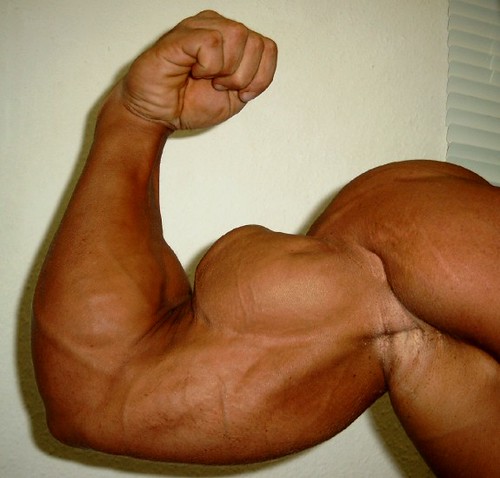
Initially beginners should aim to complete two sets of ten to twelve reps but after a few weeks, when you have developed sufficient control and basic strength, experiment with one set of six to eight reps to failure. This will maximize your muscle growth and give you the impetus to move on to the next stage of development. Before long you'll find the use of this single piece of equipment restricting, so later in this series of articles we'll pull together a muscle boosting program that utilizes other equipment to take you to the intermediate level. In the meantime, get to work with these exercises in order to get used to working your muscles.
Biceps brachii – The Two muscles at the front upper arm that run from the elbow to the shoulders. The biceps is actually a smaller muscle then the triceps. It is on the front of the upper arms. There are two heads of the biceps muscle (hence the bi in biceps).
Beneath the biceps is the brachialis, a flat muscle group that runs about half way up the upper arm bone from the elbow joint. From the rear you can see the brachialis as a well-defined band of muscle between the triceps and biceps when a muscular bodybuilder flexes his/her arm.
Triceps brachii – The Three muscles at the rear upper arm that run from the elbow to the shoulder. The triceps is a three-headed muscle that is on the back of the upper arm (hence the name tri in triceps).
Forearm – The several smaller muscles that run from the elbow to the wrist. There are three primary muscle groups in the forearms. The forearm flexors lie along the inner sides of the forearms. The forearm extensors run along the outer sides of the forearms. And the supinators that lie on the upper and outer sections of the forearms.
It is essential that when you do any exercise that you perform the movements correctly, if you don’t you will receive less then optimum benefit from the exercise. It is very difficult to unlearn bad exercise habits, so it is best to learn the right exercise technique from the very start.
The key to developing the arms is to avoid overtraining these small muscle groups. The arms are used as secondary muscles in almost all chest, back, and shoulder exercises. For example, the biceps are used when doing any type of rowing movement for the back. The triceps are used when doing any type of pressing movement for the chest and/or shoulders. And the forearms are used whenever you have to grip the weights.
Subscribe to:
Posts (Atom)